Stoic AI Explained: How the Automated Crypto Trading Bot Works, What It Costs and Who It's For
On this page
Stoic AI is an automated crypto trading bot that runs ready-made quantitative strategies on your own exchange account. You do not build or tune the bot yourself: you pick a strategy, connect your exchange, and the strategy trades for you around the clock. This guide covers how it works, what it costs, how your funds are protected, and, just as important, who it is not a good fit for.
Short answer: Stoic AI is built by Cindicator, a quant company founded in 2015, and has managed client accounts since 2020. It reports more than 20,000 clients and $230 million in cumulative assets under management. Funds stay on your exchange, pricing is a flat subscription from $24 a month with no performance fees, and the minimum to start is $500 for most strategies.
What Stoic AI is, and what it is not
Most crypto bot platforms are toolkits. They give you grid bots, DCA bots or a rule builder, and you decide the pairs, the ranges, the take-profit levels and when to switch it off. Stoic AI works the other way round. The strategies are designed, tested and maintained by an in-house quant team that has been building crypto strategies since 2017, and each one is a portfolio of many sub-strategies rather than a single bot. If you want to know how those strategies are researched and retired, we explain the full process in how our quant team builds and tests strategies.
That design has a trade-off. You get professional strategy management without configuration, but you cannot edit the strategy, add your own indicators or run your own backtests. If that kind of control is what you want, a toolkit platform will suit you better.
How Stoic AI works in five steps
- Sign up on the Stoic app, available on web, iOS and Android.
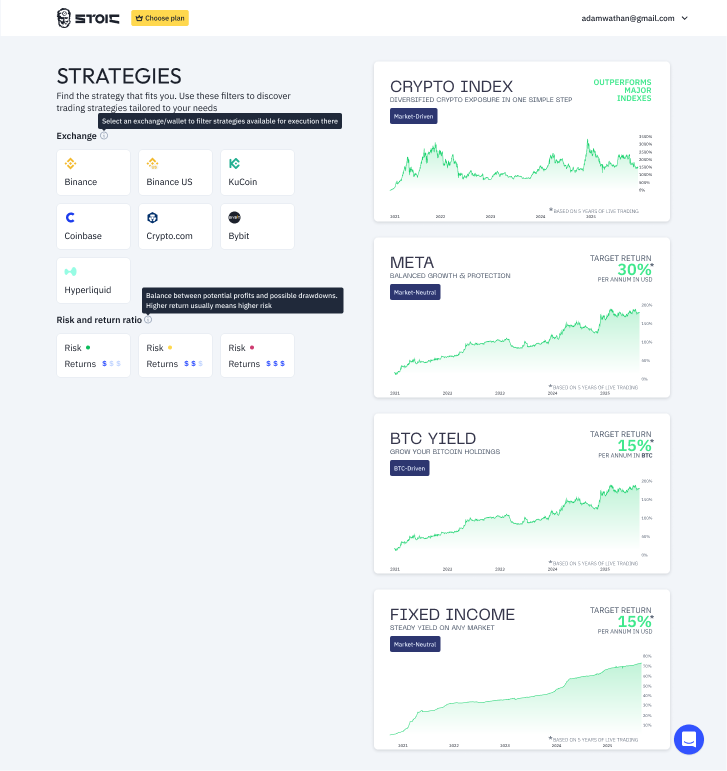
- Choose a strategy. Filters help you narrow the list by exchange, by risk and return profile, and by whether you want results that depend on market direction or stay independent of it.
- Connect your exchange with Auto-Connect or with API keys you create on the exchange. The keys need read and trade permissions only, never withdrawals.
- Let the strategy allocate. Stoic AI manages the full balance of the connected account. To run it on part of your funds, create a sub-account on your exchange, move the amount you want managed, and connect that sub-account instead.
- Monitor. Every order appears in your own exchange account, and the app shows positions and performance in real time. You can stop or disconnect at any moment.
Is Stoic AI safe? How your funds are protected
Stoic AI is non-custodial. Your crypto never leaves your exchange account, and Stoic never holds client assets. The protection comes from how the connection is built:
- Trade-only permissions. The API key allows reading balances and placing orders. Withdrawal permission is not required and should never be enabled.
- Encrypted key storage. API keys are stored in a closed, encrypted system.
- You hold the off switch. You create the key on your exchange, and deleting it ends Stoic's access instantly.
- Every trade is verifiable. Orders show up in your exchange's own trade history, not only in the Stoic app.
Non-custodial does not mean risk-free. Your funds are still exposed to the exchange you choose, so pick a major venue, enable two-factor authentication on both the exchange and Stoic, and use IP allowlisting if your exchange supports it.
Stoic AI strategies compared
Each strategy has its own page with monthly returns, maximum drawdown, Sharpe ratio and a clearly marked live-since date. The table below is a quick map of what each one is for.
The table comparing Stoic AI strategies by type, return source, main risk and minimum deposit
| Strategy | Type | Where returns come from | Main risk | Minimum |
|---|---|---|---|---|
| Stoic AI Crypto Index | Long-only | Growth of the crypto market, plus selection across 100+ sub-strategies | Falls when the market falls; large drawdowns are possible | $500 |
| Meta | Market-neutral | Relative performance of long vs short positions across 200+ sub-strategies | Relationships between assets can break down | $500 on Bybit; $1,000 on Binance and Hyperliquid |
| Automated Bitcoin Yield | Market-neutral, in BTC | The Meta engine with BTC as collateral, aiming to grow a Bitcoin holding | Results in USD also move with the BTC price | $1,000 (Binance) |
| Fixed Income | Market-neutral carry | Funding payments from offsetting spot and futures positions | Funding rates can turn negative in market stress | $500 |
| Superforecaster | Adaptive long/short | Long positions in oversold assets, shorts in persistent underperformers | Regime shifts; available by request only | $5,000 |
Many clients combine a long-only strategy with a market-neutral one, because the two are driven by different things. Before you compare numbers between strategies, check the live-since date on each page: earlier parts of some track records are backtests, and we mark where they end.
Stoic AI pricing: what it costs
Stoic AI charges a flat subscription based on the value of the exchange account you connect. There are no performance fees, no deposit or withdrawal charges, and all trading profits stay yours. Yearly billing saves up to 50%.
Prices in USD from stoic.ai/pricing, 2 Oct 2026
| Plan | Portfolio size | Monthly | Yearly |
|---|---|---|---|
| Starter | Up to $2,500 | $24 | $149 |
| Plus | Up to $5,000 | $39 | $239 |
| Pro | Up to $10,000 | $66 | $399 |
| Pro + excess fee | Above $10,000 | Pro plan plus 5% per year on the value above $10,000 | |
An example: with a $20,000 portfolio, the excess is $10,000, so you pay the Pro plan plus $500 a year. The fee depends only on portfolio size, never on profits. Portfolios above $100,000 get individual terms and a dedicated manager through Crypto Wealth Management. You can cancel anytime; the subscription stays active until the end of the billing period.
Supported exchanges
Stoic AI connects to Binance (including Binance US), Bybit, Coinbase, KuCoin, Crypto.com and Hyperliquid. Not every strategy runs on every exchange, so check the exchange page first. Results can also differ slightly between venues because of fees and liquidity, which we explain in why Stoic performance can differ across exchanges.
Stoic AI vs bot toolkits like 3Commas, Cryptohopper and Pionex
The main difference is who does the strategy work. The comparison below is about the model, not about which product is better: each fits a different kind of user.
Model-level comparison only. For prices, exchange lists and full reviews, see our comparison of 9 AI crypto trading bots
| Platform | Who designs the strategy | Where your funds sit | Pricing model | Best fit |
|---|---|---|---|---|
| Stoic AI | In-house quant team; you choose a strategy, not settings | Your exchange account, via trade-only API | Flat subscription by portfolio size | Hands-off investors |
| 3Commas | You configure DCA, grid and signal bots, or start from templates | Your exchange account, via API | Subscription tiers | Active traders who want control |
| Cryptohopper | You configure bots or buy strategies from a marketplace | Your exchange account, via API | Free tier plus subscription tiers | Traders who like to experiment |
| Pionex | You pick and set built-in bots such as grid and DCA | Deposited on the Pionex exchange | Free bots; exchange trading fees | Beginners trying simple automation |
Who Stoic AI is for, and who should skip it
A good fit if you:
- want crypto exposure or yield without watching charts or tuning bots;
- already hold funds on a supported exchange and want them to stay there;
- want a market-neutral option that does not depend on the market going up;
- prefer a predictable flat fee to a share of your profits.
Probably not a fit if you:
- want to design your own bots, indicators or scripts;
- have less than $500 to allocate;
- cannot accept the possibility of losses, including large drawdowns on long-only strategies.
Risks to understand before you start
Automation removes emotional decisions; it does not remove market risk. The long-only Stoic AI Crypto Index has had a maximum peak-to-trough decline of 68.71% over its full record, which is the cost of being invested in crypto (Bitcoin fell 76.63% over the same period). Market-neutral strategies have much smaller drawdowns but carry their own risks: correlations between assets can break, funding rates can turn negative, and any strategy's edge can fade over time. Past performance does not guarantee future results, so only allocate what you can afford to see fall.
If you are still deciding whether automation is right for you at all, our guide to algorithmic vs manual trading in crypto lays out the trade-offs on both sides.
Stoic AI FAQ
Is Stoic AI legit?
Stoic AI is built by Cindicator, a company founded in 2015. It has run client accounts since 2020, reports more than 20,000 clients and $230 million in cumulative assets under management, and publishes monthly fact sheets for its strategies. Funds never leave your own exchange account. It is also part of the Coinbase ecosystem.
Can Stoic AI withdraw my funds?
No. Stoic AI connects through API keys with read and trade permissions only, so it can place orders but cannot withdraw. You create the key on your exchange and can delete it at any time, which ends Stoic's access immediately.
How much does Stoic AI cost?
Pricing depends on portfolio size: Starter is $24 per month or $149 per year up to $2,500, Plus is $39 per month or $239 per year up to $5,000, and Pro is $66 per month or $399 per year up to $10,000. Above $10,000 you stay on Pro and add a 5% yearly fee on the value above $10,000. There are no performance fees.
What is the minimum to start with Stoic AI?
$500 for most strategies and exchanges. Meta and Automated Bitcoin Yield on Binance, and Meta on Hyperliquid, require $1,000.
Which exchanges does Stoic AI support?
Binance, Binance US, Bybit, Coinbase, KuCoin, Crypto.com and Hyperliquid. Not every strategy is available on every exchange, so check the exchange page before you connect.
Does Stoic AI make money in a bear market?
It depends on the strategy. Long-only strategies such as Stoic AI Crypto Index fall when the market falls. Market-neutral strategies such as Meta and Fixed Income are built so that their returns do not depend on market direction, but they can still lose money. No strategy guarantees a profit.
Can I stop Stoic AI at any time?
Yes. You can stop the strategy, disconnect the exchange or delete the API key whenever you want, and withdraw from your exchange account as usual. A subscription can be cancelled anytime and stays active until the end of the billing period.
Ready to see which strategy fits you? Create an account, filter strategies by exchange and risk, and connect only when you are comfortable. Your funds stay on your exchange the whole time.
You might also like
Reflecting on 2024 and What’s Ahead for AI Crypto Trading in 2025
As we step into 2025, we thank you for being part of the Stoic AI community. With AI-driven strategies gaining momentum in crypto, we remain committed to revolutionizing how crypto trading is done
Merry Cryptos! Exclusive Christmas Gifts from Stoic AI 🎄🎁
As 2024 draws to a close, we at Stoic AI want to take a moment to wish our entire community a Merry Christmas and a prosperous New Year! To make your festive season even brighter, we’ve prepared some exclusive gifts as a token of our appreciation for being a part of the Stoic AI family.
Big Gains with Stoic AI on Crypto.com!
To celebrate our recent partnership with Crypto.com, we’re offering an exclusive 25% discount to all new users who connect their Crypto.com account to Stoic AI.