How Stoic AI's Strategies Performed While Bitcoin Fell
On this page
In May 2026, while Bitcoin fell 3.5%, all four Stoic AI strategies posted positive returns: Crypto Index +10.60%, Meta +6.68%, Superforecaster +4.13%, and Fixed Income +0.40% (Binance VIP9 fees). Each carries a very different risk profile — from Fixed Income's roughly −1% maximum drawdown to Crypto Index's −69% — so the right fit depends on your risk tolerance, not just the headline return.
Down months are the real test of any trading strategy. Anyone can look good when Bitcoin is rising; the harder question is what happens to your portfolio when it isn't. May 2026 was a useful, low-drama example: Bitcoin finished the month down about 3.5%, and the volatility carried into a sharp drop in the first days of June. So it's a fair moment to ask a simple question — what did rules-based, systematic strategies actually do while the market fell? Below is how each of Stoic AI's four strategies is built, what it returned, and, just as importantly, the risk behind the number.
The market in May 2026
May was a month of chop rather than collapse. Bitcoin drifted lower to finish down roughly 3.5%, with the usual swings along the way, and conditions tightened further into early June. For a buy-and-hold holder, a down month simply shows up as a smaller balance. The point of a systematic strategy is to respond to those conditions with pre-defined rules instead of gut reactions — and a falling-Bitcoin month is exactly where the difference between the two approaches shows up.
The four strategies at a glance
Here are all four strategies side by side, with May's return shown next to the two numbers that actually describe risk: the Sharpe ratio (return per unit of risk — higher is better) and the maximum drawdown (the worst peak-to-trough fall the strategy has historically suffered). Read those last two columns as carefully as the first.
| Strategy | Style | May 2026 | Ann. return* | Sharpe | Max drawdown |
|---|---|---|---|---|---|
| Crypto Index | Long-only basket | +10.60% | varies widely | 1.42 | −68.71% |
| Meta | Market-neutral | +6.68% | 41.74% | 2.18 | −12.01% |
| Superforecaster | Long / short | +4.13% | 62.15% | 2.64 | −16.71% |
| Fixed Income | Hedged carry | +0.40% | 10.42% | 7.11 | −1.02% |
| Bitcoin (benchmark) | Buy & hold | −3.50% | — | — | −76.63% |
Crypto Index: highest return, highest risk
The Crypto Index is the most aggressive of the four, and Stoic is upfront that it carries the biggest profits and the biggest risk. It's a long-only strategy that runs a pool of 100+ sub-strategies, selecting the top 20 each week, reweighting them daily, and adjusting the assets inside them hourly — with a cap of 75% on Bitcoin and 30% on any other single asset.
In May it returned +10.60% while Bitcoin fell, a strong month. But the honest context is in the risk column: its maximum historical drawdown is about −68.71%, and it began 2026 down double digits before recovering. Because it's long-only, it's still meaningfully correlated to crypto (around 0.76 to Bitcoin) — it aims to outperform the market over time, not to sidestep down markets entirely. It has the lowest entry point of the four — from $500 on Binance and Coinbase (or $1,000 on KuCoin, Binance US, Bybit and Crypto.com) — but it suits someone who can genuinely tolerate large swings.
Meta: built to be market-neutral
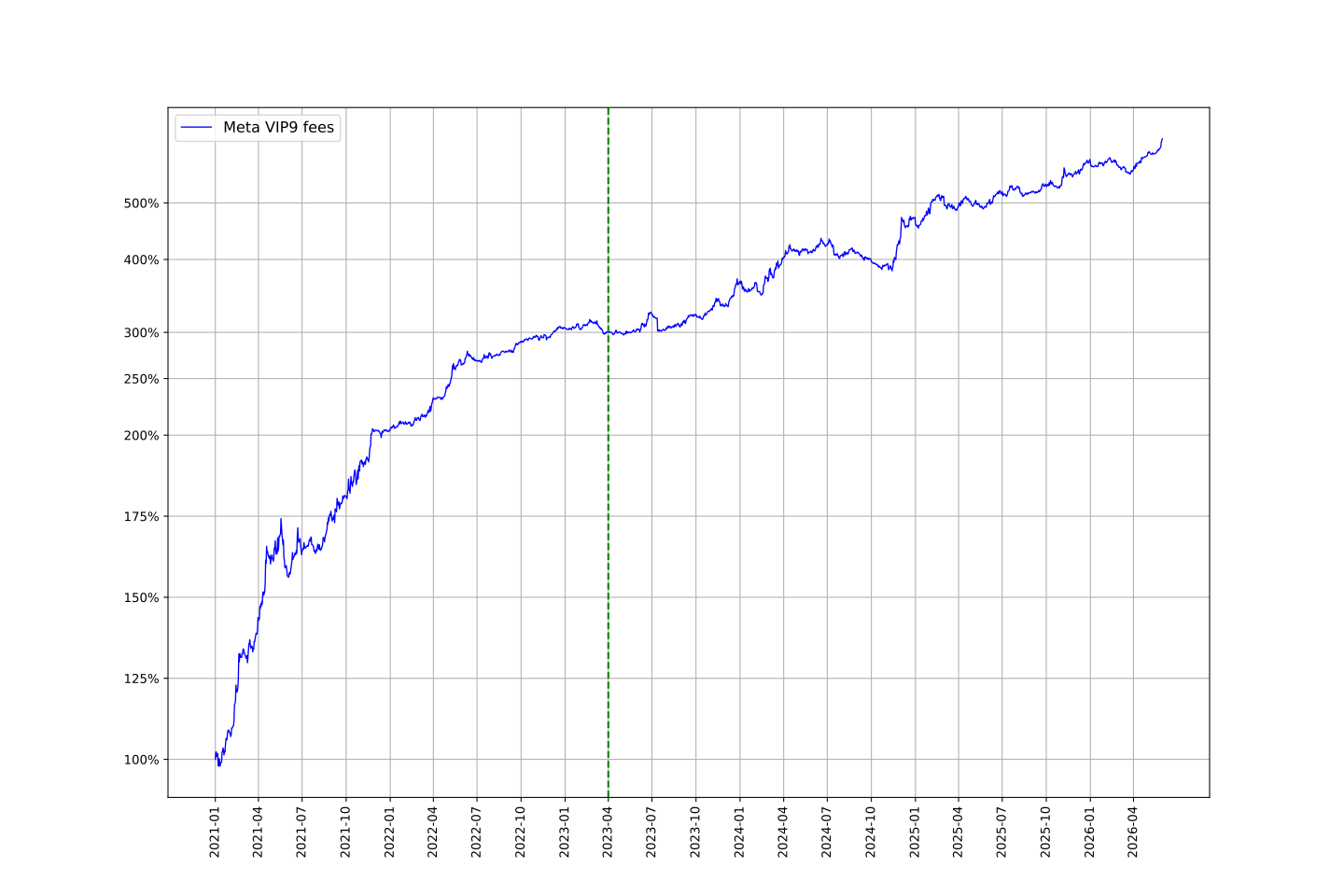
Meta is designed to make money without betting on market direction. It's a market-neutral strategy that holds many independent "alpha" signals at once, balancing long and short positions so the portfolio's net exposure stays close to zero. The goal is returns that are largely uncorrelated to whether Bitcoin is up or down — which is why it could post +6.68% in a month the market fell.
Over its 37-month live track record it shows an annualized return of about 41.74%, a Sharpe ratio of 2.18, and a maximum drawdown of around −12.01% — a much smoother ride than the Index. One thing to know: Meta is the most institution-oriented of the four, but in the Stoic app it's available to regular users from a $1,000 minimum, on the same subscription model as the other strategies (more on fees below) — not the performance-fee structure used for the institutional fund.
Superforecaster: trading both directions
Superforecaster combines two ideas. On the long side it buys assets that have become temporarily oversold, betting on a reversion toward their average. On the short side it follows a "worst performers" principle, shorting assets whose weakness looks likely to continue. Trading both directions lets it find opportunities in different conditions, with a cap of 3% on any single asset.
May returned +4.13%. Its live track shows a high annualized return of about 62.15% with a Sharpe of 2.64 and a maximum drawdown near −16.71% — higher reward and higher risk than Meta, but far more contained than the Index. The entry point is $5,000, and experienced users can optionally apply leverage between 0.5x and 3x, which raises both potential return and potential loss.
Fixed Income: fully hedged carry
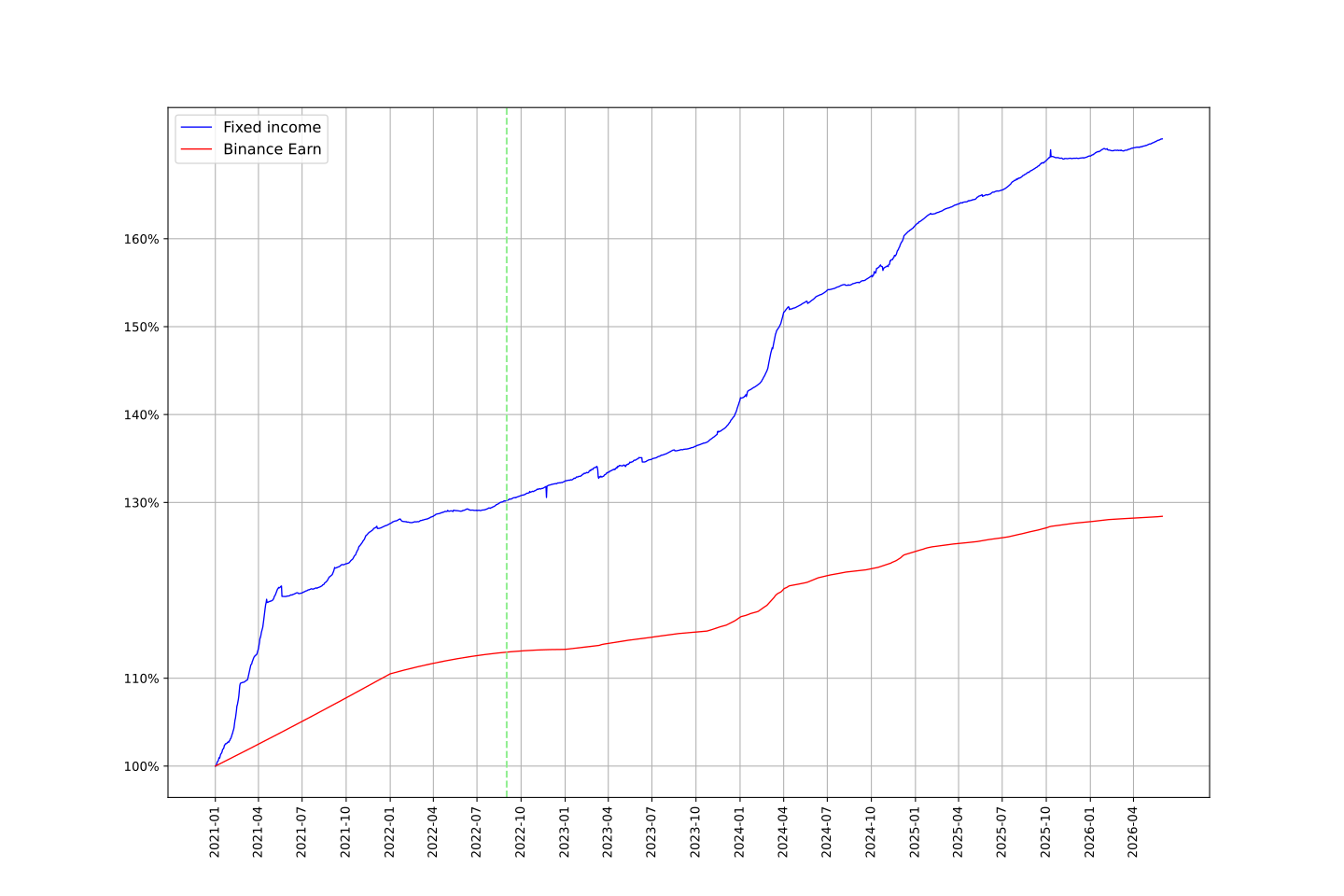
Fixed Income is the most conservative strategy and the one that looks least like directional trading. It earns from "carry" — the gap between futures and spot prices, and funding rates — while staying fully hedged: for each position it holds a long on the spot side and a matching short on the futures side, so it isn't betting on price direction at all. It sticks to the top-15 most liquid assets, capped at 10% each.
The result is a very different shape of return: +0.40% in May, an annualized figure around 10.42%, a maximum drawdown of just −1.02%, and profitable on roughly 79% of days. The strategy is designed to target a 10–20% APY range — that's an objective, not a guarantee, and a fully hedged strategy still carries risks including funding-rate shifts and execution. It's the steadiest of the four, with a $500 entry point, for users who prioritize stability over upside.
What the numbers do and don't tell you
A single positive month while the market fell is encouraging, but it's worth being clear about what it does and doesn't prove. It does show these strategies behaving as designed: the hedged and market-neutral ones held up, and the long-only one outperformed a falling market. It doesn't mean any of them will repeat that next month. The figures here use Binance VIP9 fees — the lowest tier — so most users' net results would be lower, and every annualized number is a historical, live-track figure, not a forecast.
The most useful takeaway is in the relationship between the return and risk columns: the highest annualized returns (the Index, Superforecaster) come attached to the deepest drawdowns, while the steadiest strategy (Fixed Income) returns the least. There's no free lunch — only different trade-offs, and the right one depends on how much volatility you can actually sit through without abandoning the plan.
"One good month during a market decline is encouraging, but it isn't a track record — and a strategy with a high annualized return almost always carries the drawdown to match. The point of a systematic approach isn't to win every month. It's to follow the same rules whether the market is rising or falling, so your worst decisions don't get made for you by fear in the middle of a sell-off."
— Nodari Kolmakhidze, CFO & Partner, Stoic AI
How to access Stoic AI
Stoic is non-custodial: your funds stay in your own account on a supported exchange — Binance, Coinbase, Bybit, KuCoin, Crypto.com or Binance.US — and Stoic connects through API keys that grant trading permission only, never the ability to withdraw. The strategies then run automatically, with no coding required. Minimums depend on the strategy and exchange: the Crypto Index starts at $500 on Binance and Coinbase (or $1,000 on KuCoin, Binance US, Bybit and Crypto.com), Fixed Income at $500, Meta at $1,000, and Superforecaster at $5,000. Rather than a performance fee, app users pay a Stoic subscription scaled to the size of the portfolio they connect — a cost worth factoring in alongside exchange trading fees. You can review the full numbers for every strategy in the strategy fact sheets, or set up a strategy in the app.
Frequently Asked Questions
How did Stoic AI perform in May 2026?
In May 2026, while Bitcoin fell about 3.5%, all four Stoic AI strategies were positive at Binance VIP9 fees: Crypto Index +10.60%, Meta +6.68%, Superforecaster +4.13%, and Fixed Income +0.40%. Most users pay higher fees, so individual net returns would be lower, and past performance does not guarantee future results.
Is Stoic AI custodial — does it hold my funds?
No. Stoic is non-custodial. Your funds stay in your own exchange account, and Stoic connects via API keys with trading permission only and withdrawals disabled, so it can place trades but cannot move your money out.
Which Stoic AI strategy has the lowest risk?
Fixed Income is the most conservative: it's fully hedged and market-neutral, with a maximum historical drawdown of about −1%. It also has the lowest return of the four (around 10.42% annualized historically), which reflects the usual trade-off between risk and reward.
Does Stoic AI guarantee returns?
No. None of the strategies guarantees returns. The figures shown are historical, and crypto trading involves substantial risk, including the possible loss of principal. Targets such as Fixed Income's 10–20% APY are objectives, not promises.
What's the minimum to start?
$500 for most strategies. The exceptions are $1,000: Meta on Binance and Hyperliquid, and BTC Yield on Binance. Meta on Bybit starts at $500.
The takeaway
May 2026 was a small but real stress test, and the strategies behaved the way their designs suggest they should: steadier where they're built to be steady, higher-returning where they take more risk. That's the case for a systematic approach — not that it predicts the next move, but that it keeps following the same rules when the market gets difficult. Match the strategy to the risk you can actually live with, read the fact sheets, and treat past results as context, not a promise.
This article is for informational purposes only and does not constitute investment advice. All performance figures are historical, reflect Binance VIP9 (lowest-tier) fees, and do not guarantee future results. Cryptocurrency trading involves substantial risk, including loss of principal. Do your own research before investing.
You might also like
Which Stoic AI Strategy Is Right for You?
This guide breaks down what each strategy actually does, who it works for, and — maybe most importantly — who it doesn't work for.
Meta Long Only Strategy Renamed to Stoic AI Crypto Index
Meta Long Only strategy has been renamed to Stoic AI Crypto Index. This change reflects our commitment to clarity and better represents what this strategy truly offers our users
Why Stoic Performance Can Differ Across Exchanges (Fees, Liquidity, and Trading Constraints)
Automated trading results can vary by exchange due to fees, liquidity, trading constraints, and regional rules. This guide breaks down why the same strategy may perform differently across venues and how to compare results fairly